
15 Aug Sign Got Damaged in a Storm Who Fixes It: A Broken Arrow, OK Repair Guide
Oklahoma’s hail season reaches its sharpest peak season in a six-week stretch from mid-April to mid-May, based on decades of Tulsa-area climate records, and when a business sign got damaged in a storm who fixes it becomes the most urgent question for owners across Broken Arrow, OK. A pole sign that took a direct hit from wind-driven hail or straight-line wind gusts is a safety issue as much as a cosmetic one, since a loose panel or damaged electrical component near a parking lot or drive-through lane needs attention before customers ever notice the dent. The good news is that most storm-related sign damage falls into a small number of repeatable categories, and knowing which one applies determines both who handles the repair and roughly what it will involve.
Who Is Responsible for a Storm-Damaged Business Sign?
In almost every case, the business that owns the sign is the party responsible for getting it repaired, regardless of whether the property itself is owned or leased. That said, the lease agreement between a tenant and a landlord sometimes assigns exterior signage maintenance to the property owner rather than the tenant, so it is worth checking that document before assuming who pays for the work. Multi-tenant retail centers and freestanding pole signs shared by several businesses are the most common places this distinction actually matters, since a shared monument sign damaged in a storm can involve more than one party in the repair decision.
What does not matter is who originally built or put up the sign. A sign technician evaluates the current condition of the cabinet, the electrical components, and the structure itself, not the name on the original permit. That is true for the installation as much as it is for the ongoing service, and it means a business does not need to track down the original installer after a storm. General repairs already follow this same logic for wear-and-tear issues, and storm damage is handled no differently: the sign gets fixed based on what is actually wrong with it. Having a basic emergency plan in place ahead of storm season, including a repair contact already on file, saves time when a sign needs attention right after a storm rolls through.
The person who ends up making the first call after a storm is usually whoever notices the damage first, which in practice is often a manager opening the store rather than an owner or a landlord. That first call does not need to include a final decision about repair, replacement, or insurance. It only needs to get a technician scheduled to look at the sign in person, since a visual inspection from a parking lot rarely tells the full story about what is happening inside the cabinet or at the base of a pole structure. Taking a few photos of the damage from multiple angles before anything is touched or temporarily covered is worth doing at this stage too, since that documentation can matter later regardless of whether the repair ends up being a simple fix or something that eventually involves a claim.
Sign Got Damaged in a Storm Who Fixes It: What the Repair Process Involves
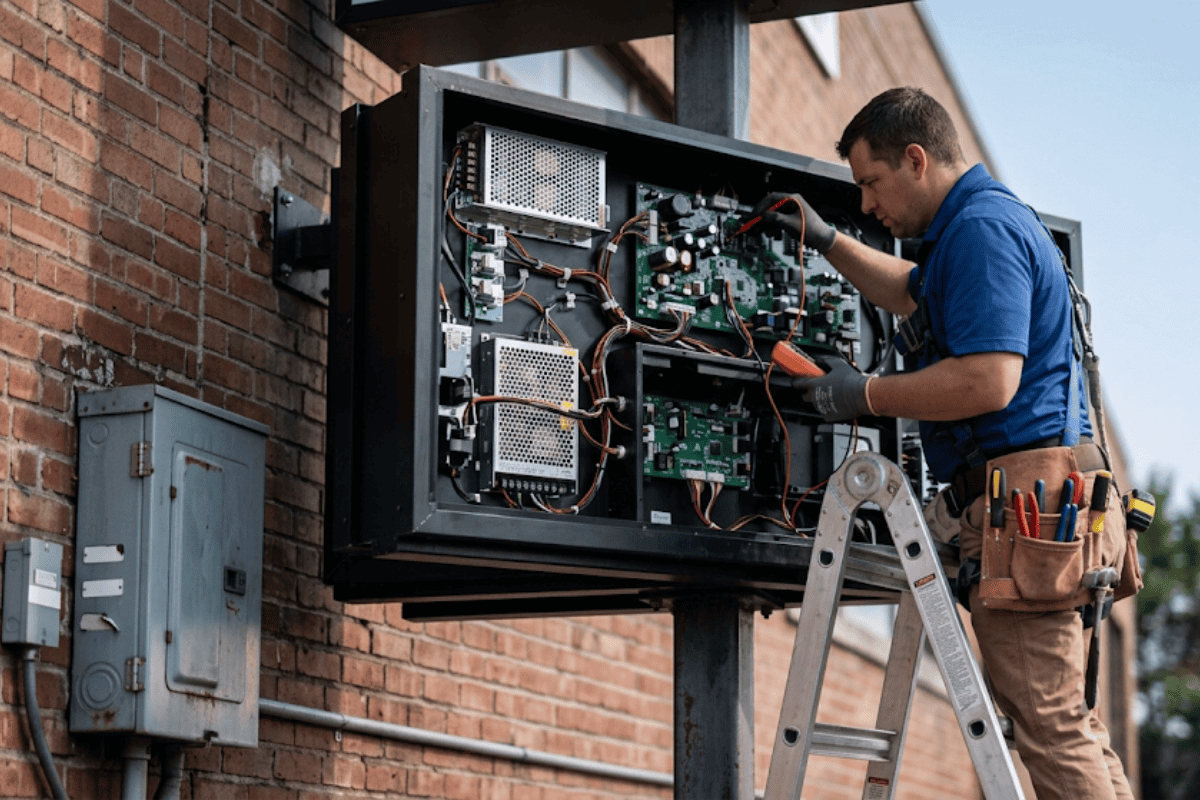
Once a business decides to move forward with repair, the process generally starts with a safety check rather than a cosmetic assessment. A technician confirms that any exposed wiring is de-energized and that a leaning or partially detached cabinet is not at risk of falling before doing anything else. After the sign is safe to approach, the inspection covers three broad areas: the cabinet and face material, the electrical and lighting components, and the mounting structure or foundation.
From there, the specific repair depends on what the inspection turns up. A cabinet or panel bent by wind pressure is typically straightened, reinforced, or refaced through reconditioning and refurbishing rather than replaced outright, since the underlying frame is often still structurally sound. Electrical and lighting damage, which frequently follows a power surge during a storm, is addressed through diagnosis of the transformer, ballast, or LED driver, sometimes paired with an LED retrofit if the original lighting is outdated or was already due for an upgrade. A cracked cabinet gets patched, resealed, or has the damaged section replaced to keep moisture out of the internal wiring. Damaged mounting hardware or a compromised foundation gets reinforced or reset so the structure is stable again, which matters more than it might seem given how much lateral force a sign structure can absorb during a storm. Independent wind load testing on sign structures has shown that wind pressure on a cabinet face is a major factor in structural failure, which is part of why a mounting or foundation check after a storm is not optional even when the damage looks purely cosmetic from the ground. In rarer cases involving classic neon tubing, storm-related vibration or a direct impact can crack the glass, and that damage is handled through neon restoration rather than a modern retrofit, preserving the original look rather than replacing it with something different.
If a sign is unstable but cannot be fully repaired the same day, a temporary measure such as bracing a leaning cabinet or capping exposed wiring is usually put in place first, with the permanent repair scheduled once the right materials are on hand. Matching materials is a bigger part of the timeline than most owners expect, since a faded acrylic panel or a specific paint color from years ago sometimes needs to be color-matched or sourced before the visible repair can be finished, even though the structural work underneath can often move forward right away.
When Does Insurance Get Involved in Storm Sign Repair?
Whether insurance enters the picture usually comes down to the cost of the repair relative to the policy’s deductible. Severe convective storms, the category that includes tornadoes, hail, and straight-line wind, generated tens of billions of dollars in insured losses nationwide in a recent year alone, which is a reminder that exterior property damage claims, including signage, are common rather than unusual after a significant storm system moves through. A minor repair, such as resetting a loose panel or replacing a single damaged light component, often costs less than the deductible and gets handled directly without ever involving a claim.
Larger repairs, particularly ones involving a damaged foundation, a full cabinet replacement, or extensive electrical rebuilding, are more likely to justify filing a claim. Most businesses carry signage under a broader commercial property policy, frequently structured as part of a business owner’s policy that bundles property coverage with general liability. When a claim is filed, an adjuster typically wants to see the damage before repairs begin, so documenting the condition with dated photographs immediately after the storm, before any cleanup or temporary fix, makes the claims process considerably smoother. A repair estimate from a sign technician also gives the adjuster a clear scope of work to evaluate, which tends to move the claim along faster than a vague damage description alone.
Wind and hail deductibles are also worth double-checking before assuming a claim makes sense, since some commercial policies apply a percentage-based deductible for these specific perils rather than a flat dollar amount. That structure can mean a business absorbs a larger share of a moderate repair than it would with a standard fixed deductible, which is part of why comparing the repair estimate against the actual deductible amount, rather than guessing, is worth the extra few minutes before a claim gets filed. None of this needs to be sorted out before a technician is called, since the inspection and the estimate typically happen well before any insurance decision is finalized.
| Type of Storm Damage | Typical Repair Approach |
|---|---|
| Wind-bent panel or cabinet | Straightened, reinforced, or refaced through reconditioning and refurbishing rather than full replacement. |
| Electrical or lighting damage from a power surge | Transformer, ballast, or LED driver diagnosis, often paired with an LED retrofit. |
| Cracked cabinet | Patched, resealed, or the damaged section replaced to keep moisture out of internal wiring. |
| Damaged mounting or foundation | Hardware reinforced or the foundation reset to restore structural stability. |
Why Choose Acura Neon for Storm Sign Repair in Broken Arrow, OK
A sign left leaning, dark, or partially detached after a storm is not something that can wait weeks for a callback. Fast local response matters most in the days right after severe weather moves through Broken Arrow, OK, when a business needs someone to assess whether a damaged sign is safe, whether it needs temporary bracing, and what the actual repair will involve. Getting eyes on the sign quickly is often the difference between a straightforward fix and a problem that gets worse from continued exposure to weather.
Reconditioning and refurbishing capability is the other half of the equation. A bent cabinet, a damaged mounting structure, or a section of failed lighting can frequently be repaired using the existing foundation and frame rather than requiring a full replacement, which tends to be the more cost-effective path for most storm damage. That capability, combined with lighting-outage response and neon restoration for older signage, covers the range of issues a storm typically causes without defaulting to a rebuild as the first option.
Get a Storm Damage Repair QuoteIf a sign in the Broken Arrow or Tulsa, OK area was damaged in a recent storm, request a quote and a technician can assess the structure, the wiring, and the mounting before recommending a repair.
Conclusion
A realistic expectation after any significant storm is that most sign damage, even damage that looks severe from the street, can usually be repaired rather than replaced, as long as the foundation and frame are still structurally sound. The rule of thumb worth remembering is to get the sign inspected before assuming the worst, since a leaning cabinet or a dark lighting section often points to a contained, fixable problem rather than a total loss. Businesses in Broken Arrow, OK dealing with storm damage do not need to wait until the next billing cycle or slow season to get an estimate, particularly when a dark or damaged sign is actively affecting how customers find the business.
Schedule a Storm Damage Inspection, To find out what a specific storm-damaged sign needs, contact Acura Neon’s Broken Arrow team and describe the damage, including whether any wiring is exposed or the structure appears unstable.
Frequently Asked Questions
Who is responsible for fixing a business sign damaged in a storm?
The business that owns the sign is typically responsible for arranging the repair, though a lease agreement in a multi-tenant property sometimes shifts exterior signage maintenance to the landlord. It does not matter which company originally installed or built the sign, since any qualified technician can evaluate and repair it based on its current condition.
Does business insurance cover storm damage to a sign?
Most commercial property policies, including those bundled into a business owner’s policy, cover wind and hail damage to exterior signage as a standard peril. Coverage details and deductibles vary by policy, so reviewing the specific policy language or asking an agent directly is the most reliable way to confirm what applies to a given claim.
Is a damaged sign the landlord’s or the tenant’s responsibility?
It depends on the lease. Many commercial leases assign exterior signage maintenance and repair to the tenant, while others place that responsibility on the property owner, particularly for shared monument or pole signs used by multiple businesses. Checking the lease language is the only reliable way to know which party is responsible in a specific situation.
How much does it typically cost to repair storm damage to a sign?
Cost varies widely based on the type and extent of damage, ranging from a minor panel adjustment or a single lighting component to a full cabinet or foundation repair. Because pricing depends heavily on what an in-person inspection reveals, an estimate from a technician is generally the only accurate way to know the cost for a specific sign.
Can a storm-damaged sign be repaired instead of fully replaced?
In most cases, yes. As long as the foundation and frame remain structurally sound, damage such as bent panels, cracked cabinets, or failed lighting components can usually be addressed through repair, reconditioning, or retrofit rather than a full rebuild. Full replacement generally only becomes necessary when the structural foundation itself is compromised beyond repair.

Sorry, the comment form is closed at this time.