
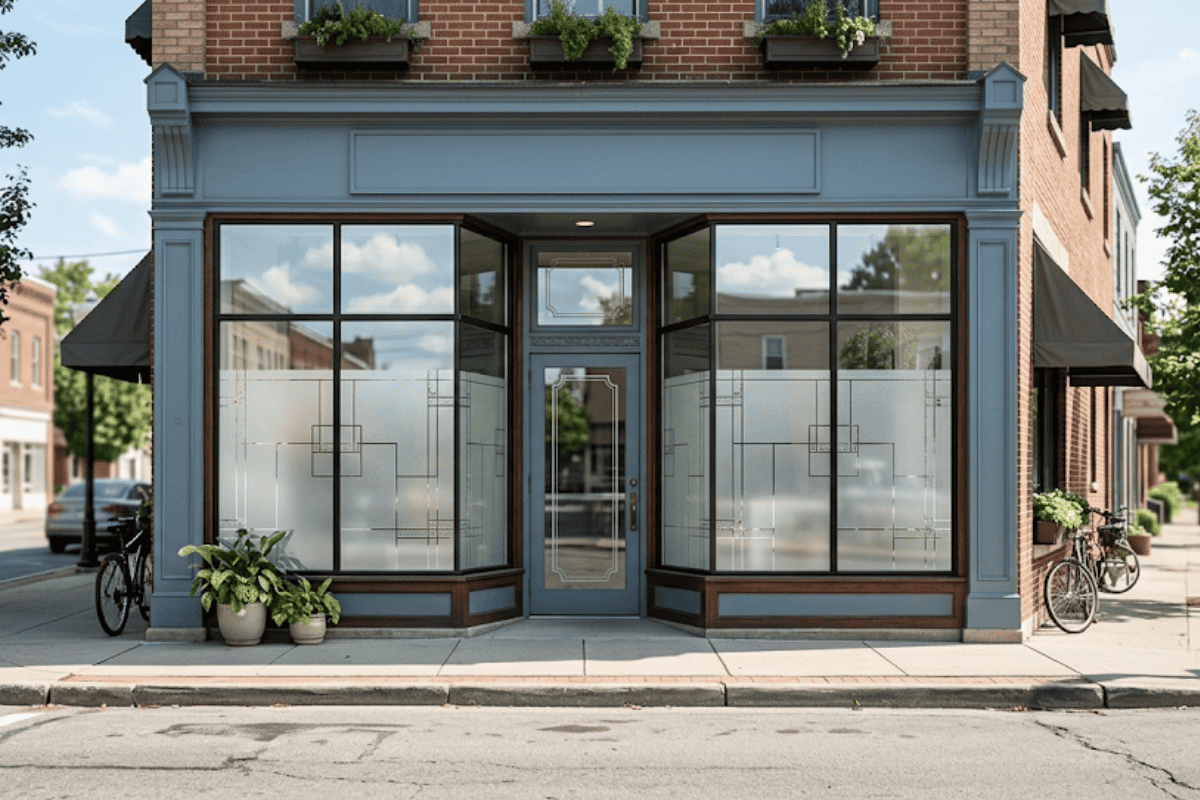
11 Aug Can Window Graphics Keep My Store Cooler in Summer?
Tulsa’s official July climate normal, recorded just up the road from Broken Arrow, OK, puts the average afternoon high at 93.6 degrees Fahrenheit, and unprotected storefront glass facing south or west routinely runs hotter than the air around it, which is exactly the situation that makes business owners ask can window graphics keep my store cooler in summer. The honest answer is yes, but only when the film is matched to the window it is covering, since a light privacy film and a true solar-control film do very different jobs once the sun hits the glass. Window graphics work by managing how much solar energy actually gets through the pane in the first place, not by cooling the air after the fact, and that distinction determines how much relief a storefront actually feels on a 95-degree afternoon in Broken Arrow, OK.
Can Window Graphics Keep My Store Cooler in Summer: How Solar Heat Actually Enters a Storefront
Sunlight carries three types of energy through a pane of glass: visible light, ultraviolet radiation, and infrared heat. The infrared portion carries close to half of the total solar energy that reaches a window, and research from the University of Central Florida’s Florida Solar Energy Center points to blocking infrared specifically, rather than just darkening the glass, as the real lever for cooling a storefront. Film engineers describe that lever with two numbers: the Solar Heat Gain Coefficient, or SHGC, which measures how much solar heat actually passes through the glass and film together, and the Light-to-Solar-Gain ratio, which compares how much visible light gets through relative to how much heat does. The solar heat gain ratio guidance from that research center is straightforward: for a film to meaningfully cut heat, its SHGC needs to land somewhere below 0.3 to 0.5, and the lower that number runs, the more heat stays outside the glass instead of radiating into the sales floor.
The U.S. Department of Energy’s own window treatments guide recommends sun-control or reflective film specifically for south-facing and west-facing glass, since those orientations catch the most direct summer sun in the afternoon, exactly when a Broken Arrow storefront is busiest and the HVAC system is working hardest. That is also why a single film choice rarely fits an entire storefront. A shaded entry door and a wide west-facing display window are dealing with two different heat loads, even though they are ten feet apart on the same wall.
Can Window Graphics Keep My Store Cooler in Summer? What the Research Shows
The research answer to can window graphics keep my store cooler in summer is yes, with real numbers behind it. A federal building study conducted by Lawrence Berkeley National Laboratory found that low-e window film cut perimeter HVAC energy use by an average of 29 percent compared to single-pane clear glass, by blocking direct solar heat before it could load the cooling system. A separate national lab study on solar control film modeled combined heating and cooling savings of about 20 percent on single clear glass in hot climates comparable to Oklahoma summers, and measured roughly 30 percent cooling-only savings on exterior-applied film over double glazing during the warmest monitored months. Neither study claims a storefront will feel like a walk-in cooler the moment film goes on the glass, but both point to the same mechanism: heat that never gets absorbed by the glass in the first place never has to be removed by the air conditioner later.
There is a secondary comfort factor too. Beyond blocking heat, quality window film also blocks a large share of ultraviolet radiation; UV protection data from the International Window Film Association shows films can block up to 99 percent of UV rays, the same energy responsible for fading merchandise, signage, and flooring near a sunny window, so the cooling benefit and the fade-protection benefit come from the same installation.
Find Out Which Film Fits Your Storefront Windows. Every exposure reacts differently once the sun hits it, so the fastest way to know which film category fits a specific window is an in-person estimate rather than a guess from a spec sheet, especially on a storefront with more than one type of window exposure.
Comparing Window Graphic and Film Types by Light Block and Heat Block
Not every vinyl option on a storefront window is built to fight heat, and mixing up the categories is the most common reason a business installs film and still feels the afternoon sun. Perforated vinyl, the kind used for printed one-way-vision graphics, is manufactured in ratios like 60/40 or 50/50, meaning 40 percent or 50 percent of the surface is actual open perforation with no film covering the glass at all; that open area is what makes it possible to see out from inside, but it also means a large share of the window’s heat load passes straight through the holes, so perforated vinyl is a branding and one-way visibility tool first and a heat-control product only as an afterthought. Frosted and translucent privacy film sits in the middle: a commonly specified frosted product transmits about 34 percent of visible light and roughly 39 percent of solar heat, meaning it blocks around 61 percent of the heat that would otherwise pass through bare glass, while also blocking up to 99 percent of UV. Printable or opaque graphics, the kind used for full window branding or blackout coverage, block close to 99 percent of visible light wherever the graphic is solid, and they stop nearly all direct solar transmission through that covered area, though the Lawrence Berkeley National Laboratory research above found that darker, absorptive films can reach surface temperatures of 120 to 140 degrees Fahrenheit on the glass itself, so opaque coverage benefits from attention to ventilation behind the vinyl on the hottest exposures. Solar or heat-control film, the spectrally selective type built specifically for energy performance, keeps visible light transmission around 64 percent for a comfortable, non-dark appearance, while cutting solar energy transmission to about 36 percent, the combination behind the 20 to 30 percent cooling savings measured in the research above.
| Film Type | Visible Light Blocked | Solar Heat Blocked | Best Window Exposure |
|---|---|---|---|
| Perforated Vinyl (One-Way Vision) | Roughly 40 to 50% open, no film | Low, since open perforations pass heat directly | Shaded or lower-sun windows used mainly for branding |
| Frosted / Translucent Film | About 66% blocked (34% VLT) | About 61% blocked (39% solar heat transmittance) | Side or partially shaded windows needing privacy |
| Printable / Opaque Graphics | About 99% where the graphic is solid | High direct block, but surface can reach 120 to 140 degrees F | Full-coverage branding on any exposure with ventilation considered |
| Solar / Heat-Control Film | About 36% blocked (64% VLT) | About 64% blocked, SHGC as low as 0.3 to 0.5 | South and west-facing glass with the heaviest direct sun |
Why Choose Acura Neon for Window Graphics in Broken Arrow, OK
A storefront rarely has just one type of window exposure. The same building can have a west-facing display window that bakes all afternoon and a shaded side entrance that barely sees direct sun, and running the same film across both misses the point of matching heat-control performance to what a given pane actually deals with. Acura Neon’s process starts by looking at each window on its own: which direction it faces, how much of the day it sits in direct sun, whether awnings or neighboring buildings already provide shade, and what the business actually needs that window to do, whether that is branding, privacy, glare control, or straight heat reduction. That match starts with a site-specific design consultation before any vinyl is cut, so a heavily sun-exposed west window can get a solar or heat-control film while a shaded side window gets a lighter frosted or perforated option instead of paying for heat-rejection performance it does not need.
Because Acura Neon cuts vinyl in-house rather than ordering pre-cut film from an outside supplier, adjustments for window trim, existing signage, mullions, and curved or angled glass happen on the same visit instead of a second round trip. That in-house cutting also matters for how long the film holds up, since fit and edge sealing are two of the biggest factors in film lifespan: a size typed into a web form has no way to account for a curve in the glass, a decorative mullion, or hardware sitting near the edge of the pane, and gaps like that both look wrong and let film lift early.
A few signs point to which window on a given storefront is the best candidate for heat-control film first:
- The glass faces south or west and gets direct sun for more than a few hours a day
- Merchandise, signage, or flooring near the window shows visible fading
- The HVAC unit serving that side of the building runs noticeably more than others
- Employees or customers near that window describe it as noticeably warmer than the rest of the space
- The window currently has no film, tint, or covering of any kind
Acura Neon has served Broken Arrow, OK, Tulsa, OK, and the wider four-state region of Oklahoma, Kansas, Arkansas, and Missouri since 1988 as a family owned and operated, Native American owned business holding Cherokee Nation and Muskogee Creek Nation TERO and CESO certification, and the company is UL listed, fully insured, licensed, and bonded for the vinyl work it designs, cuts, and installs.
Conclusion: Getting the Right Film for a Broken Arrow Storefront
A good rule of thumb for any storefront: match the film to the window’s worst hour of sun, not its average hour, since a west-facing display window that bakes for three hours every afternoon needs a different film than one that only catches soft morning light. Most Broken Arrow, OK businesses find that a mixed approach, solar-control film on the windows that take direct afternoon sun and a lighter frosted or perforated option everywhere else, gets the best balance of comfort, visibility, and cost, rather than treating every window on the building the same way. Realistically, window film will not eliminate an HVAC bill or turn a hot storefront cold on its own, but paired with the right film for each exposure, it takes a meaningful bite out of the heat load the air conditioner has to fight every afternoon.
Talk Through Your Storefront’s Window Film Options. Reach out to Acura Neon with the directions your storefront windows face, and the team can recommend which film belongs on which pane before any vinyl gets cut.
Frequently Asked Questions
Does window film actually keep a room cooler, or does it just reduce glare?
Window film does both, but the cooling effect and the glare effect come from different properties of the film. Reducing glare mainly comes from tinting or lowering visible light transmission, while cooling comes from lowering the amount of solar heat, mostly infrared energy, that passes through the glass. A film can be lightly tinted and still cut a meaningful amount of heat if it is engineered with a low solar heat gain coefficient, so glare reduction alone is not a reliable measure of how much heat a film actually blocks.
How much heat can window film block on a hot day?
The amount varies by film type, but spectrally selective solar-control films are commonly rated to keep solar heat gain coefficients between roughly 0.3 and 0.5, meaning they block a large share of the solar energy that would otherwise pass through untreated glass. Federal building research has measured average HVAC energy savings near 29 percent on perimeter zones after low-e film was installed over single-pane glass. Basic tinted or decorative films block noticeably less heat than films engineered specifically for solar control.
Will window film also help control heat loss in winter?
Some films provide a modest insulating benefit by lowering the glass’s emissivity, which slows heat loss through the pane in cold weather, but this effect is generally smaller than the summer cooling benefit. Most standard solar-control or privacy films are designed primarily to manage incoming solar heat rather than to trap indoor heat during winter. A building that wants meaningful winter performance typically needs a film or window system specifically rated for low emissivity rather than a general-purpose solar or privacy film.
Does window film block UV rays completely?
No film blocks 100 percent of UV radiation, but quality window films can block up to 99 percent of UVA and UVB rays, which covers nearly all of the ultraviolet energy responsible for fading fabric, flooring, and merchandise near a window. The small remaining percentage is generally not enough to cause noticeable fading or sun damage compared to unprotected glass. Standard glass without any film blocks some UV on its own, but far less than glass paired with a UV-rated film.
How long does solar or heat-control window film typically last before it needs replacing?
Most quality solar-control and privacy films are built to perform for around a decade under normal sun exposure before performance noticeably declines. Films installed on windows with the most direct, sustained sun exposure tend to show wear, such as fading or edge lifting, sooner than films on shaded or lower-exposure windows. Regular inspection for bubbling, peeling edges, or discoloration is the most reliable way to know when a film is due for replacement.

Sorry, the comment form is closed at this time.