

24 Mar ADA-Compliant Signage Requirements Every Business Should Know
Business signage serves many purposes—it identifies your brand, guides customers through your space, and reinforces your professional image. But signage also plays a crucial role in accessibility. For individuals with disabilities, properly designed and placed signs help ensure they can navigate buildings safely and independently.
This is where ADA-compliant signage comes in. The Americans with Disabilities Act (ADA) established guidelines to ensure that public spaces—including businesses—are accessible to everyone. ADA-compliant signage requirements help people with visual impairments, mobility challenges, and other disabilities easily find entrances, restrooms, exits, and other important areas.
For business owners, understanding ADA signage requirements isn’t just about avoiding penalties. It’s about creating an inclusive, welcoming environment where every customer can move confidently through your space. In this guide, we’ll break down the key ADA signage requirements every business should know and how compliant signage improves both accessibility and customer experience.
What Is ADA-Compliant Signage?
ADA-compliant signage refers to signs designed according to standards set by the Americans with Disabilities Act. These standards ensure that individuals with disabilities—including those who are blind, visually impaired, or mobility-limited—can identify rooms, navigate buildings, and access essential facilities.
ADA signage typically includes features such as:
- Raised characters
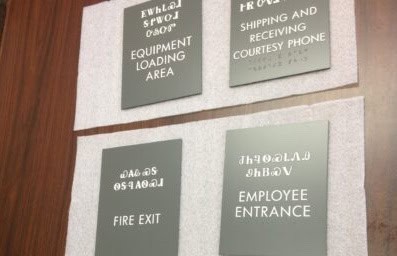
- Braille text
- High-contrast colors
- Specific mounting heights
- Consistent placement
These elements allow people to read signs visually or by touch, making navigation possible even without full sight. Businesses that serve the public—including offices, retail stores, restaurants, medical facilities, hotels, and educational institutions—are generally required to comply with ADA signage guidelines.
Why ADA Signage Matters
Many business owners think of ADA signage primarily as a legal requirement. While compliance is certainly important, the impact goes far beyond regulations.
Proper signage:
Promotes accessibility. People with visual impairments rely on tactile signs and Braille to locate rooms and facilities.
Improves navigation. Clear signage helps everyone—including first-time visitors—find their way easily.
Demonstrates inclusivity. Businesses that prioritize accessibility send a strong message that all customers are welcome.
Reduces confusion and frustration. Clear directional signage minimizes questions and helps customers feel comfortable.
In short, ADA signage improves the experience for every visitor, not just those with disabilities.
Where ADA-Compliant Signs Are Required
Not every sign in a building must follow ADA guidelines. However, certain types of signage are required to meet accessibility standards.
Permanent Room Identification
Rooms that have permanent functions must include ADA-compliant identification signs. Examples include:
- Restrooms
- Conference rooms
- Offices
- Mechanical rooms
- Storage rooms
- Classrooms
These signs typically feature raised characters and Braille so they can be read by touch.
Exit and Emergency Signs
Emergency exits must be clearly marked and accessible to everyone. While some exit signs fall under building codes rather than ADA rules, accessibility remains an important consideration. Clear placement and visibility ensure that people can safely exit a building during emergencies.
Directional and Wayfinding Signs
Directional signs that guide visitors toward restrooms, elevators, or accessible entrances should also follow ADA guidelines when appropriate.
Wayfinding signage is particularly important in large buildings, multi-suite offices, and healthcare facilities where navigation may be more complex.
Accessible Features
Any feature designed for accessibility must be identified with proper signage. Examples include:
- Accessible parking spaces
- Accessible entrances
- Elevators
- Assistive listening systems
These signs help individuals quickly locate accommodations designed to support them.
Key ADA Signage Design Requirements
To meet ADA standards, signs must follow several specific design guidelines. These requirements ensure signs can be easily read both visually and through touch.
Raised Characters
ADA signs must include raised lettering so they can be identified by touch. Key requirements include:
- Characters raised at least 1/32 inch
- Uppercase letters
- Simple, sans-serif fonts
Decorative or script fonts are typically not permitted because they are harder to read.
Braille
Braille must be included on signs identifying permanent rooms or spaces. ADA guidelines specify Grade 2 Braille, which uses contractions to represent words and phrases efficiently. Braille should be positioned directly below the raised text so users can easily locate it.
High Contrast
Color contrast is essential for readability.
Signs should use high-contrast combinations such as:
- Dark text on a light background
- Light text on a dark background
Low-contrast color schemes may look stylish but can make signs difficult to read for people with visual impairments.
Non-Glare Surfaces
ADA-compliant signs must have matte or non-glare finishes. Glossy materials can reflect light and create glare, making text difficult to read. A non-reflective finish ensures signs remain legible in various lighting conditions.
ADA Mounting and Placement Guidelines
Even a perfectly designed sign can fail to meet ADA standards if it’s mounted incorrectly. Placement rules ensure signs are easy to locate and read.
Mounting Height
ADA guidelines typically require tactile signs to be mounted so the baseline of the lowest raised characters sits between 48 and 60 inches from the floor.
This height range allows people who are standing, seated, or using wheelchairs to access the sign comfortably.
Door Placement
Room identification signs should usually be placed:
- On the latch side of the door
- On the wall adjacent to the doorway
This placement allows individuals to locate the sign consistently, even when doors are open. If a door does not have a latch side or space is limited, the sign should be positioned in the nearest accessible location.
Clear Floor Space
ADA signage must also allow sufficient space for individuals to approach and read the sign. Obstructions such as furniture, decorations, or fixtures should not block access.

Common ADA-Compliant Signage Mistakes Businesses Make
Even well-intentioned businesses sometimes fall short of ADA standards. Here are some common mistakes to avoid.
Incorrect Braille
Using the wrong Braille format—or omitting Braille entirely—is one of the most frequent compliance errors. Professional signage providers ensure Braille meets proper ADA specifications.
Poor Color Contrast
Designing signs that match a brand color palette but lack sufficient contrast can reduce readability. Balancing branding with accessibility is essential.
Incorrect Mounting Height
Signs installed too high or too low can violate ADA guidelines and make them difficult to reach. Consistent placement across all signage is important.
Using Decorative Fonts
While stylized fonts may look attractive, they can be difficult for visually impaired individuals to interpret Simple fonts improve clarity and compliance.
How ADA-Compliant Signage Enhances Customer Experience
While ADA signage is designed to support individuals with disabilities, it also improves usability for everyone.
Visitors benefit from:
- Easier navigation
- Clearer building organization
- Faster identification of key areas
- Reduced confusion in unfamiliar spaces
Businesses that prioritize accessibility often see improvements in overall customer satisfaction. When guests feel comfortable and confident moving through a space, they’re more likely to return. In many ways, ADA signage functions as an extension of good customer service.
The Importance of Professional Signage Expertise
ADA signage involves more than adding Braille to a sign. Compliance requires understanding detailed federal guidelines, local building codes, and proper installation practices.
Working with a professional signage company helps ensure:
- Accurate design specifications
- Correct materials and finishes
- Proper mounting and placement
- Full compliance with ADA regulations
Professional signage providers also help businesses integrate ADA requirements seamlessly with their overall branding and interior design. The goal is signage that is both compliant and visually appealing.
ADA Compliance and Brand Identity
Some business owners worry that ADA signage will clash with their brand aesthetic. In reality, modern materials and fabrication techniques allow ADA-compliant signs to blend beautifully with interior environments. Custom signage can incorporate:
- Brand colors
- Coordinated materials
- Architectural finishes
- Custom mounting styles
The result is signage that supports accessibility without sacrificing design. In fact, many businesses find that ADA signage enhances their overall professionalism and attention to detail.
Stay Compliant and Accessible With ADA-Compliant Signage
ADA-compliant signage is essential for creating accessible, welcoming spaces for everyone who enters your business. From raised lettering and Braille to proper placement and design, meeting ADA requirements ensures that all customers can navigate your location with confidence and independence.
At Acura Neon, we understand the details involved in ADA signage and how to integrate those requirements into high-quality, custom sign solutions. Our team can help guide you through the design, fabrication, and installation process to ensure your signage meets accessibility standards while still reflecting your brand. If you’re planning a new build, renovation, or signage update, we’re here to help create signage that is both compliant and impactful.
Sorry, the comment form is closed at this time.